

Limescale is patient. It arrives in thin chalky layers you barely notice, then one morning the kettle sounds like it is chewing gravel and your tea tastes oddly flat. You do not need a specialist descaler to fix that. White vinegar does the heavy lifting, and baking soda finishes the job — both are probably in your cupboard right now. The trick is using them in the right order, because the popular "mix them together and boil" version mostly wastes both. Here is the full method, from the first soak to the last rinse.
Why Vinegar and Baking Soda Work — Separately
That crusty white film inside your kettle is mostly calcium carbonate, the same mineral that furs up shower heads and taps. It dissolves in acid. White vinegar is dilute acetic acid: cheap, food-safe, and it rinses away cleanly.
Baking soda does a different job entirely. It is a mild alkali and a gentle abrasive. Used as a paste, it scours away soft deposits on the base plate and brightens the outside of the kettle. Used in solution, it neutralises any acid left behind and knocks back stale smells.
Here is the part most people get wrong: mixing vinegar and baking soda together in the kettle produces a satisfying fizz of carbon dioxide and salty water, and cancels out the acid you actually need for descaling. Use vinegar to dissolve the scale, then baking soda to clean up afterwards. Not both at once.
Before You Start: A Two-Minute Checklist
- Unplug the kettle and let it cool completely. Pouring vinegar into a hot kettle is a scalding risk and does nothing useful.
- Check the manual. Some manufacturers specify their own descaler, and a few warn against acidic cleaners on particular coated interiors. Aluminium-bodied kettles should not get vinegar at all.
- Open a window. Boiled vinegar smells sharp and lingers in small kitchens.
- Never submerge the base or the cord. Wipe the outside with a damp cloth only.
- Have a soft cloth or non-scratch sponge ready. Metal scouring pads will scratch the heating plate and give future scale somewhere to grip.
Step-by-Step: The Vinegar Descale
- Empty the kettle and give it a quick rinse with warm water.
- Mix one part white vinegar with two parts water. For heavily scaled kettles, go one-to-one. You need enough liquid to cover the heating element and base by about an inch.
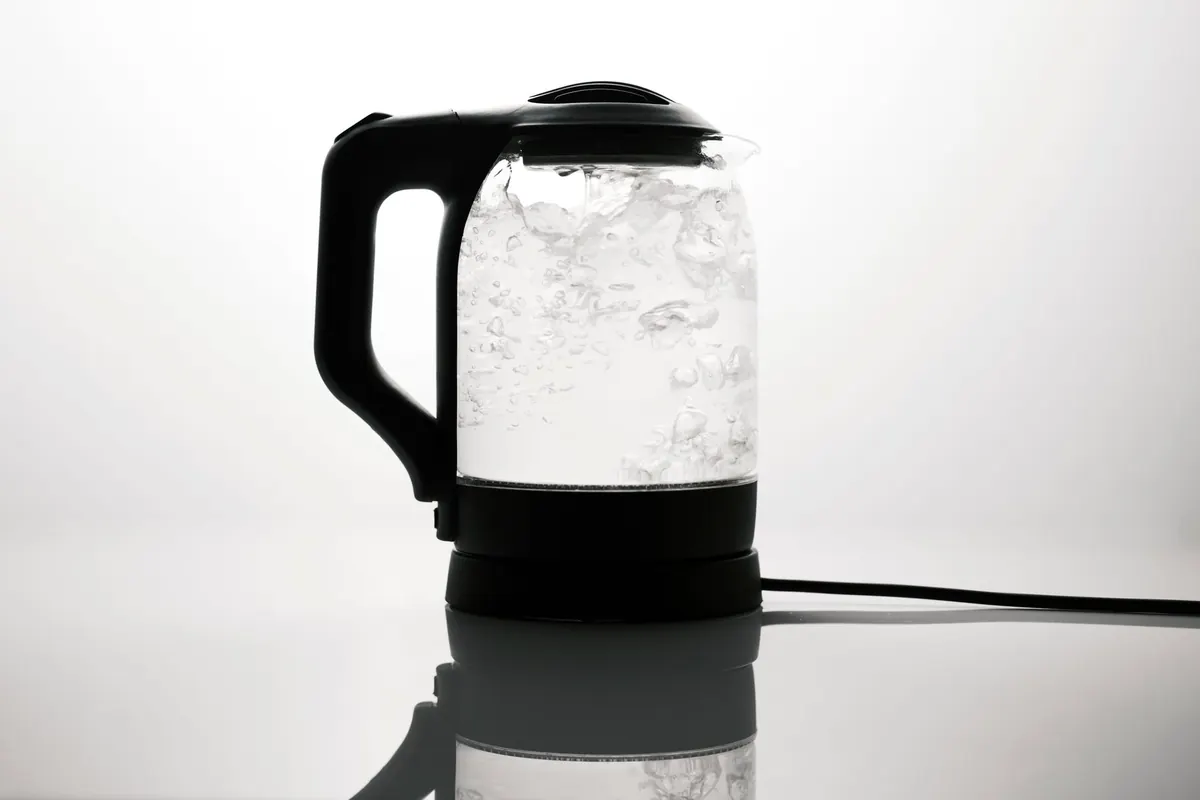
- Pour it in, switch the kettle on, and let it come to a boil. Switch off as soon as it clicks — do not let it boil dry.
- Leave it to stand for 20 to 30 minutes. For thick, rock-hard scale, give it an hour, or leave it overnight if your manual allows it.
- Pour the liquid out. You will often see flakes and grit in the sink. That is the scale coming off.
- Repeat once more if a chalky ring is still visible.
Dealing with stubborn patches
Make a paste from three parts baking soda to one part water. Rub it onto the base plate and the inside walls with a soft cloth, then rinse thoroughly. The paste is mildly abrasive, so use light pressure and let the vinegar soak do most of the work first. Do not scrape at the element with a knife, spoon handle or anything metal.
The rinse cycle — do not skip it
Fill the kettle with fresh cold water, boil it, and pour it away. Do that three times. Then boil one more batch, let it cool, and taste a sip. If there is any vinegar tang, boil and dump again twice more. Vinegar residue makes tea taste strange and coffee taste worse, and leaving acid sitting on metal parts is not kind to them.
Take the removable filter out and wash it separately with warm soapy water. It collects scale faster than anywhere else in the kettle, and descaling the body while leaving a clogged filter in place is half a job.
Where Baking Soda Actually Helps
Baking soda is a finisher, not a descaler. On its own it will not dissolve calcium carbonate, no matter how long you leave it. Its real uses are these:
- Neutralising. Add a tablespoon to a full kettle of water after descaling, bring it to a boil, then pour it out. Any acid residue is gone.
- Odour. A kettle that smells musty or has been sitting unused benefits from one baking soda boil.
- The exterior. A paste lifts tea stains, fingerprints and light scorch marks from stainless steel and glass.
- The base plate. Gentle scouring for soft, freshly formed film.
One caution: never add baking soda to a kettle of hot vinegar and put the lid back on. The fizzing is fast, messy and can push foam out over your worktop.
How Often to Descale — and When to Repeat
Water hardness decides your schedule, not the calendar. As a general guide:
- Soft water areas: every two to three months.
- Moderately hard water: every four to six weeks.
- Very hard water or daily heavy use: every two to four weeks.
Watch for the signals rather than relying on the date. A visible white film on the base plate, a longer boil time, a rumbling sound, or a faint chalky taste in your tea all mean it is time. If one descaling cycle leaves scale behind, run the whole process again rather than reaching for something stronger. Two or three gentle rounds beat one harsh chemical treatment.
If you cannot stand the smell of vinegar, citric acid powder works on the same principle and rinses just as cleanly. Warm water with a sliced lemon will also handle very light scale, though it is not strong enough for a neglected kettle.
Keeping Scale From Coming Back
Descaling is easier the less often you have to do it. Empty the kettle after every use instead of leaving a puddle sitting on the element, and never store it with water inside. Only boil the amount you need, since minerals concentrate as water evaporates. If your tap water is hard, filtering it first makes a noticeable difference over a few months, and it improves the taste of the tea too.
Finally, be realistic about a kettle that has never been cleaned. Vinegar will lift a decade of scale, but it may take three or four cycles with fresh solution each time. If the element is pitted, the coating is flaking, or the kettle leaks, cleaning is no longer the problem — replace it. A working kettle that boils quickly and tastes neutral is worth more than a stubborn one you keep fighting.
Photo: djedj / Pixabay
Related posts
More stories you’ll love reading