
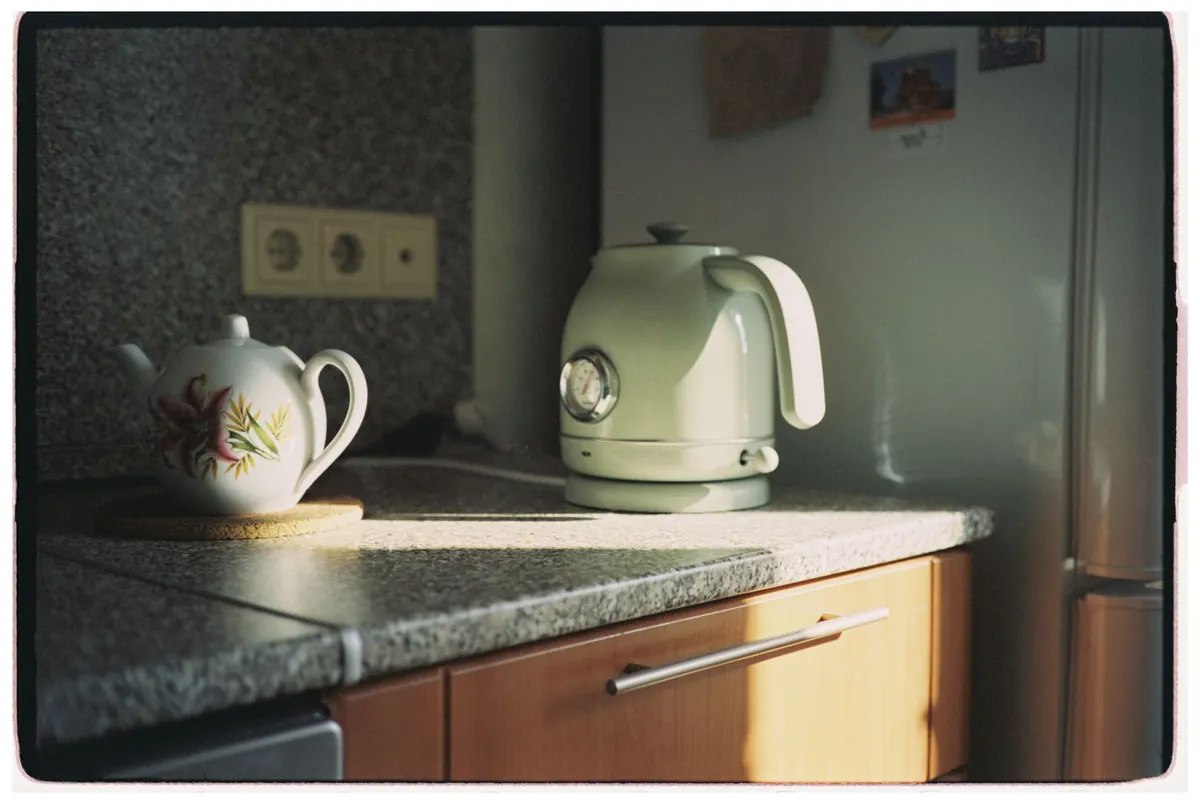
Most electric kettles do the same basic thing: heat water, then switch themselves off. That simplicity is exactly why buying your first one can feel harder than it should. The differences between a budget kettle and an expensive one are small, specific, and easy to overlook until you've lived with the thing for a month. These five specs — capacity, wattage, material, temperature control, and safety — are the ones that genuinely change your mornings. Everything else is trim.
Capacity: Match the Kettle to Your Mugs
Start by counting what you actually boil. A teacup holds about 200 ml, a mug 300 to 350 ml, and a French press or large travel tumbler can swallow 500 ml or more. Kettles are sold by maximum capacity, usually somewhere between 0.5 and 1.8 liters.
One person drinking two or three mugs a day is well served by a 1-liter kettle. Two tea drinkers boiling at the same time will be happier with 1.5 liters. If you host, cook, or fill a French press for a crowd, 1.7 liters — the most common size — is a safe default.
Two details matter as much as the headline number:
- The minimum fill line. Every kettle has one, usually around 0.5 liters, because the heating element must stay submerged. A big kettle doesn't let you boil a tiny amount faster — you still have to fill it to that line. If you only ever make one cup, a smaller kettle saves water and electricity.
- Weight and clearance. A liter of water weighs a kilogram. A 1.7-liter stainless kettle, filled, is close to 3 kg and needs several inches of room above it to lift the lid. Measure your counter before you buy.
Wattage: How Fast, Not How Hot
Wattage tells you how quickly a kettle boils. It doesn't change the temperature the water reaches — that's always 100°C (212°F) at sea level unless you set a lower target.
Where you live determines what you can buy. In the US and Canada, with 120 V outlets, most kettles draw 1,500 W and a few reach 1,800 W; a full 1.7-liter kettle takes roughly five to six minutes. In the UK, Europe, and Australia, where outlets run 230–240 V, 3,000 W is standard and the same kettle boils in about three minutes. That voltage difference is why a kettle bought abroad may never perform properly at home, and why a plug adapter alone isn't the answer.
One warning worth remembering: a kettle, a microwave, and a toaster oven all compete for the same circuit. If a breaker trips when you boil water while something else is running, move one appliance to a different outlet. High-wattage appliances belong in a wall socket, not at the end of a cheap extension cord or an already-loaded power strip.
Material: What Touches Your Water
- Stainless steel. Durable, doesn't hold flavors, and survives the occasional knock. Brushed finishes hide fingerprints and scratches better than polished ones. Heavier than plastic, and the exterior gets hot, so look for a cool-touch handle.
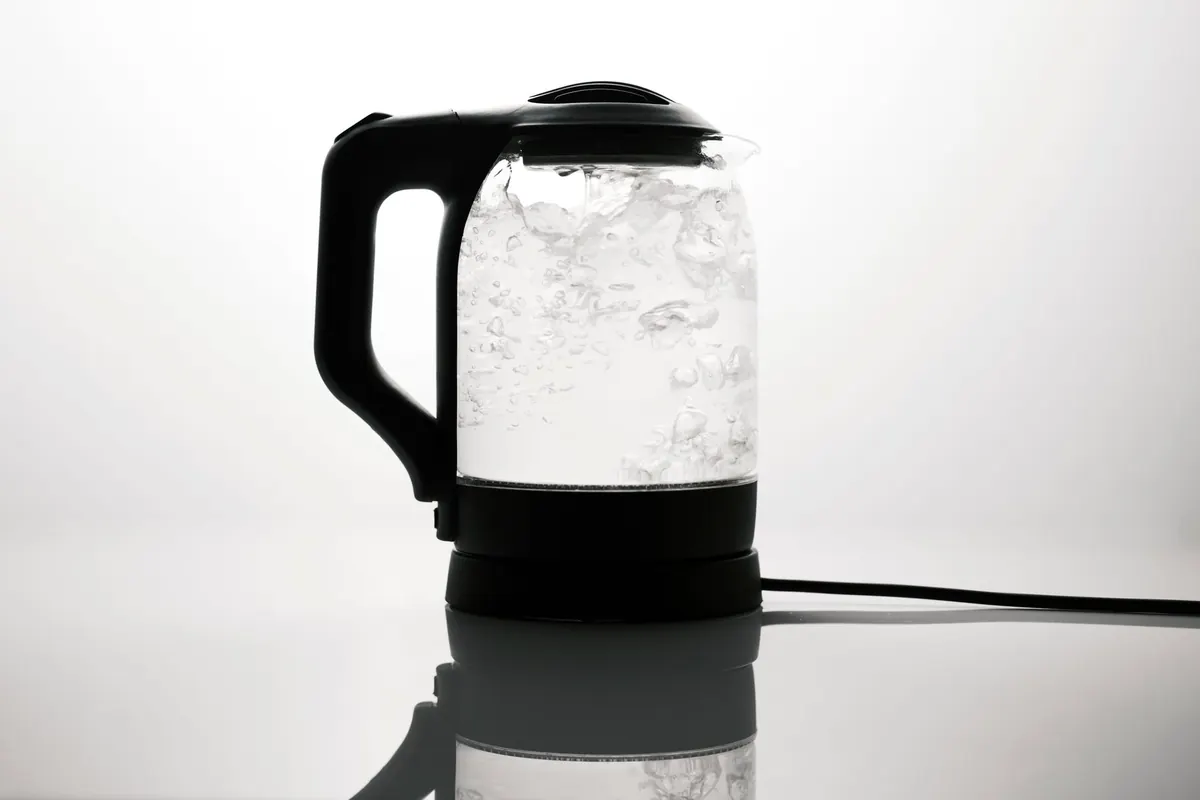
- Glass (borosilicate). You can see the water, the boil, and the scale, which makes cleaning less of a guess. It's heavier and breakable, and scale shows up sooner simply because it's visible. Check that the base plate is stainless steel, since that's the part in contact with your water.
- Plastic. Light, inexpensive, and cooler on the outside. Look for BPA-free, and confirm the element and interior parts are stainless steel. Clear plastic can yellow over years of heating.
- Ceramic. Attractive enough to leave on the counter and good at holding heat. Also heavy, slower to heat, and prone to chipping at the rim.
Whatever the body is made of, the parts that meet water should be stainless steel. Double-walled models keep water hot noticeably longer, which is genuinely useful if you sip slowly or want a second pour.
Temperature Presets: Worth It for Some Drinkers
If you drink black tea, instant coffee, or boil water for cooking, a simple on/off kettle is all you need. Skip this section and save your money.
If you brew green tea or pour-over coffee, temperature matters. Water straight off a rolling boil can make delicate green tea bitter and pour-over taste harsh. A variable-temperature kettle lets you choose a target and stop there. Typical settings you'll see:
- 70–80°C (160–175°F) for green tea
- 80–85°C (175–185°F) for white tea and lighter oolongs
- 90–96°C (195–205°F) for pour-over coffee and French press
- 100°C (212°F) for black tea, herbal infusions, and cooking
Don't overthink the exact numbers — a preset that's five degrees off won't ruin your drink. What matters is having a few useful stops instead of one boiling point. Pay attention to how you set them, too: physical dials and buttons work fine with wet hands, while app-controlled kettles are convenient until your phone is in the other room. Keep-warm functions hold a temperature for half an hour or so, which is handy for a second cup, though they draw power the whole time.
Safety Features to Confirm
Kettles are among the safer appliances in a kitchen, largely because the important safety features are inexpensive and now nearly universal. Still, confirm these before you buy:
- Automatic shut-off at boiling. Standard on almost everything, but verify it.
- Boil-dry protection. Cuts power when there's too little water, which is what happens when someone switches it on and walks away.
- A lid that locks or stays shut while pouring. This is the feature that keeps near-boiling water out of your lap. <
Photo: Elena Golovchenko / Pexels
Related posts
More stories you’ll love reading